
Q&A with Jefa Greenaway
This month I sat down with Jefa Greenaway RAIA MDIA, Founder and Director of Greenaway Architects.
He is also the CoFounder and Director of Indigenous Architect + Design Victoria [IADV], an Honorary Fellow of Design - School of Communication and Creative Arts, Faculty of Arts & Education (Deakin University), Board Member for Homes Victoria, Senior Lecturer at University of Melbourne, and one of the most grounded people I have ever met.
It was a pleasure to sit down with him and chat about his impact on our industry, how he balances his roles and ways in which he gives back.
Q: Coffee order
Jefa: Pretty easy, it’s a strong latte. As architects we have coffee coursing through our veins, I try to stick to one or two a day.
Q: Favourite lunch spot in Melbourne
Jefa: That’s a hard one because we have such a good food culture here in Melbourne. For a quick lunch maybe Pellegrini on Bourke Street; It’s a little bit of an institution from the late 50s; you get a nice lasagne there, nice coffee and they do a really nice apple strudel. If you want something a bit more lux, I’d go Di Stasio.
Q: You’re actively involved in many roles, how do remain so present in each?
Jefa: I think it’s about segmenting what you’re doing at that point in time, so while I wear many hats, ultimately, it’s about focusing on what you’re doing then and there. It’s also about the notion of deep listening, when you’re engaging with something, one of the most important skills to build up overtime is to speak less and listen more.
Q: Do you find when you’re stressed, your mind starts to wander, or do you make a conscious effort to leave it at the door?
Jefa: Yeah, I tend to park that kind of stuff. Stress is more a product of not knowing what you need to do next, so essentially its inaction through sometimes being overwhelmed by having multiple things that you’re juggling. I really think it’s best to step through quite methodically the things you need to get through, having that sort of structure enables you to tick off things.
Q: What do you enjoy about each of your roles?
Jefa: Well, they’re all quite distinct – There’s practice, there’s academia, and then there’s advocacy. They are interconnected in many ways, but practice is really the creative outlet and I guess it supports what ones trained in; I’m trained as an architect and so I want to realise built form outcomes. The practice really is the distillation of many years of study and experience, whereby academia is really about giving back.
I spent 10 years in tertiary study so there’s a sense of obligation and responsibility to pass on knowledge, that in part is why I do it. One gains a lot through the learning journey at university but there are very few practitioners involved in academia. Having that practice perspective to pass on is something I value as being important to enable tangible project examples.
The advocacy roles which involve role modelling, public speaking and agitating for meaningful change is a legacy piece, to ensure the ideas we embed are listened to and engaged with. We can shift the dial in terms of the dialogue of how we engage; particularly with embedding different perspectives, enabling design equity and to support these ideas as part of normative practice.
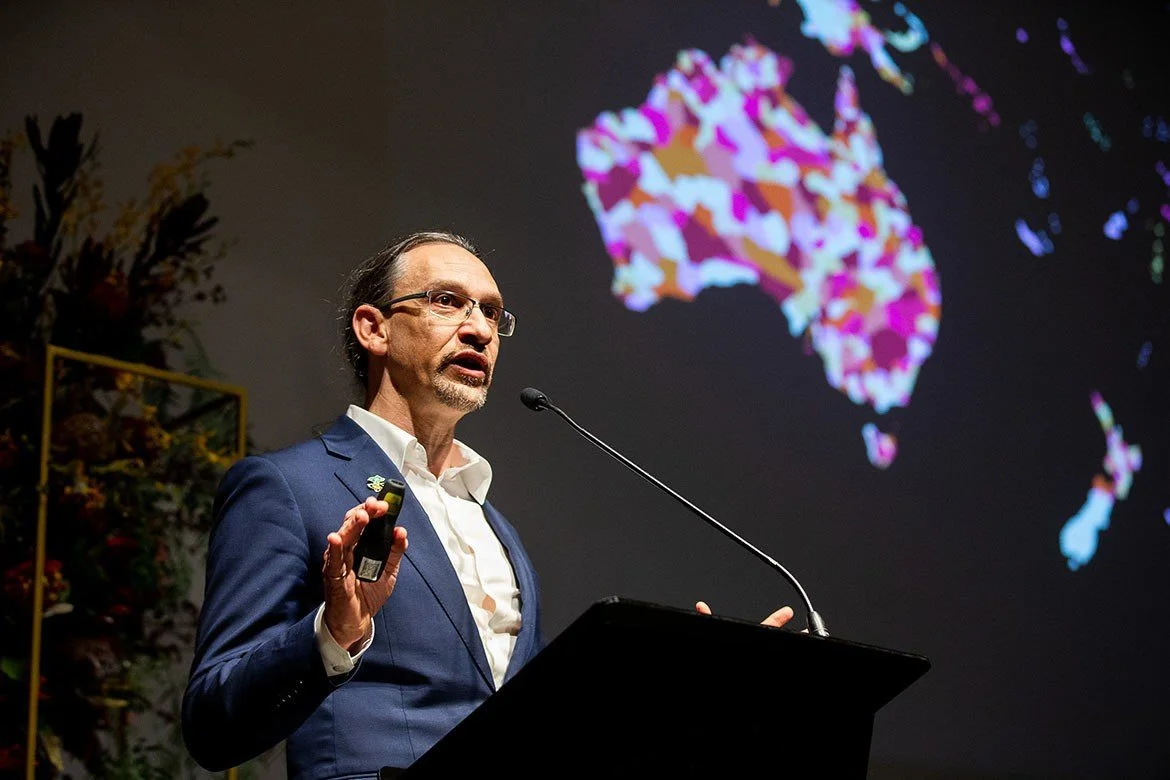
Photo above: Jefa Greenaway at Venice Biennale, photography by Peter Casamento.
Q: What are you looking forward to over the next year, personally and professionally?
Jefa: Building the practice. We’ve now got a presence in New South Wales in Sydney so we’re trying to build that up. We’ve also got a number of really high-profile projects which are not yet determined, ones that I’m hoping will transpire into viable projects. It will mean I can really sink my teeth into projects of great depth, meaning, impact and importance.
Q: What’s the most memorable compliment you’ve ever received?
Jefa: Yeah, that’s a hard one. Because we’re in a culture of criticism as opposed to compliments, it’s not something you commonly hear. I had a profile done for Indesign magazine recently, in a way it was a compliment in terms of the title for the article. It was titled ‘Powerhouse for Change’. I found that quite a positive way of framing what I do, because the interview tracked the journey from inception to where I am now. It was a real chronicle of my career and what I’ve done and the range of things I tend to juggle. There’s a depth there to capture the sentiment that sits behind it, so that article title to me was quite a compliment.
Q: What advice would you give your younger self.
Jefa: Be persistent, work hard, and it’s the people around you which support your journey, more than the formal training per say. And always look for mentors and work with the best to become the best.
I’ve been fortunate enough all the way through, probably from high school, college and university; I’ve always had a series of mentors. People who kind of take you under their wing and give you opportunities and open doors, and you can just show up at their office and have a yarn.
Q: Were your mentors informal?
Jefa: Totally informal. We see a lot of formalised structured mentoring opportunities and processes now coming out of universities, the Institute of Architects and others. For me it’s always been informal and it’s about building an affinity. Invariably I think what tends to happen is mentors gravitate towards those who are curious, those who work hard, those that have an enquiring mind, those who ask questions – because it shows you’re engaged and connected, and you’re wanting to grow. Mentors really help you flourish.
Q: Do you mentor people at the moment?
Jefa: Obviously through teaching, you are in many respects acting as a mentor, certainly within the Indigenous practitioners space. I’ve mentored a lot of younger members of the profession coming through and they’ll often just give me a call and say I’ve got this problem, what should I do? Or how do I navigate that? And obviously with the cultural dimension it adds another layer; one knows they can speak to someone in practice with the same heritage and background, who understands some of the nuances behind it. You can relay examples of the issue faced or acknowledge the challenge and say this is how you navigate it. That’s certainly something I take on as an important responsibility.
Q: Do you have a mentor yourself?
Jefa: Not at the moment. Because also what tends to happen is mentors are there at a time you need them and then they tend to become less relevant as you progress and build your own skills and competency. They tend to come in and out. They kind of come at the right time. For instance, some of the lecturers I’ve had at university, I invited to my wedding; so you build that strong affinity and commitment, connection, and relationship as well. So yeah, it becomes less a formality in how they’re assisting you and often subtly shifting as they become friends.
There were quite a few common threads during my conversation with Jefa; the one that stands out the most is the importance of the people you surround yourself with. Similarly to Jefa, I have been lucky enough to have informal mentors throughout my career who have assisted me in making career decisions and also helped to navigate certain situations; they have also become good friends.
To quote Jefa, 'towork with the best to become the best' really is the quickest and most enjoyable way to become a master of your skill, elevate your own personal brand and increase your impact.